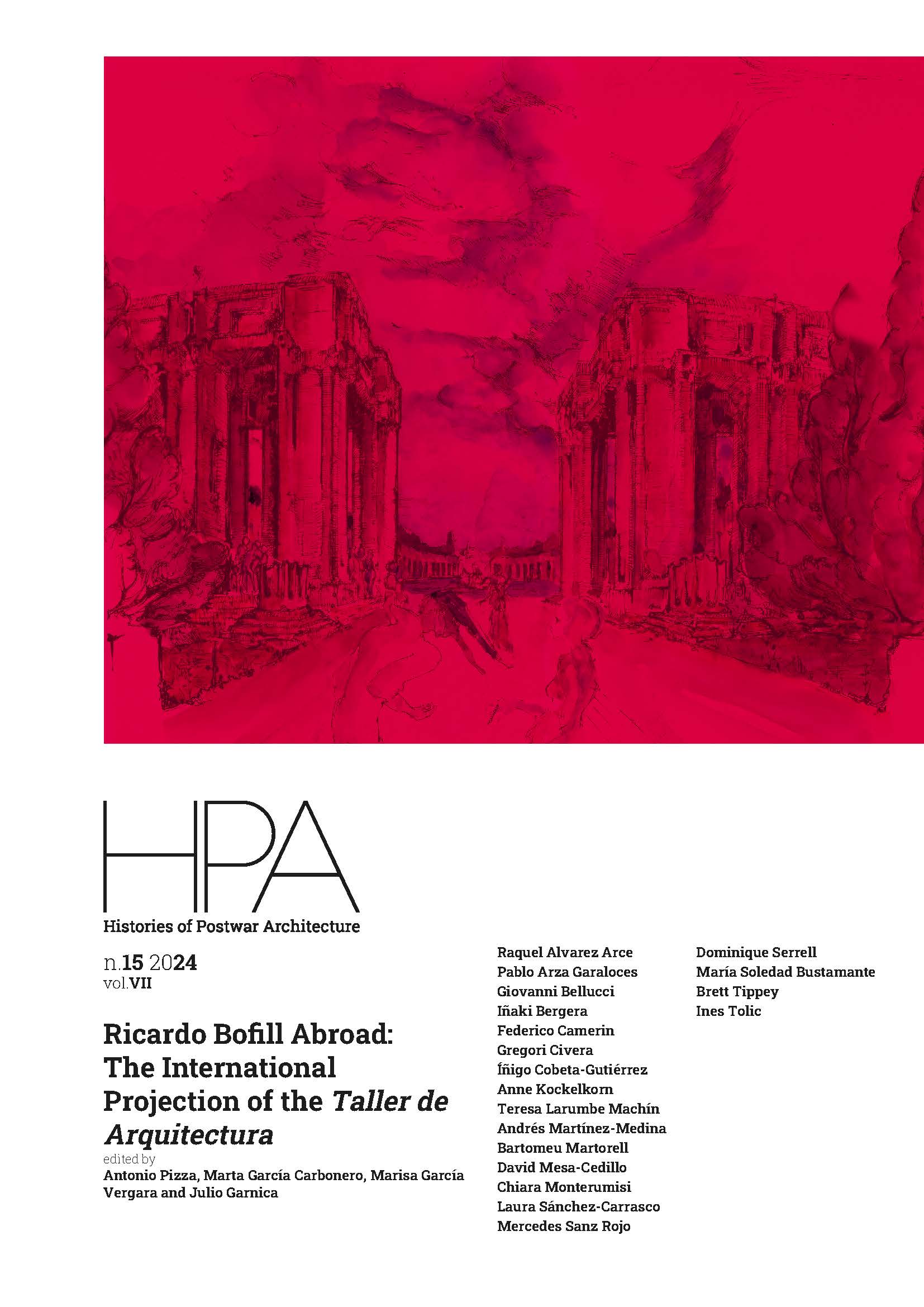
Ricardo Bofill from Both Sides of the Wall. RBTA’s reception in German Architectural Journals during the Late Cold War (1975 –1990)
DOI:
https://doi.org/10.6092/issn.2611-0075/21500Keywords:
Ricardo Bofill, Villes Nouvelles, West Germany (FRG), East Germany (GDR), Cold War ArchitectureAbstract
This article examines how Ricardo Bofill Taller de Arquitectura (RBTA) was produced, contested, and instrumentalized in the architectural journals of West and East Germany between 1975 and 1990, with brief antecedents from the early 1970s. Using a reception-studies approach to texts from Bauwelt, Baumeister, ARCH+, Der Architekt, Deutsche Bauzeitung, and Architektur der DDR, the paper argues that RBTA’s combination of classical monumentality and prefabrication during the so-called “French years” operated as a technology of image whose meaning shifted with the patronage regimes and evaluative frameworks on each side of the Wall. In the FRG, criticism crystallized around three value regimes—moral-aesthetic (the trauma of monumentality), urban-functional (the user and the built environment), and political-economic (the image of public power and corporations)—turning RBTA into touchstone of local cultural debates. In the GDR, reviewers acknowledged technical prowess yet evaluated RBTA primarily through the lens of industrialisation and socialist planning priorities. By triangulating these readings with Bofill’s own programmatic texts, the article shows how German journals did not merely “reflect” RBTA; they constructed it as a sign within late–Cold War urban politics. The contribution is twofold: a comparative map of RBTA’s German receptions and a broader diagnosis of how prefabrication can act as symbolic accelerator—either as a public expression of authority or as an operation of urban legibility—depending on the political context.
References
Adelmann, Maria Franziska. “In Ricardo Bofills Reich.” Bauwelt, no. 1–2 (1983): 26–35.
Architektur und Wohnform, “Apart Hotel ‘El Castell’, Sitges, Spanien”, Architektur und Wohnform, no. 7 (1971): 300-302.
Barth, Thomas and Topfstedt, Thomas. Vom Baukünstler zum Komplexprojektanten: Architekten in der DDR. Dokumentation eines IRS. Sammlungbestandes biographischer Daten. Erkner: IRS, no. 3 Regio Doc, 2000.
Baumeister, “Kafkaeske Burg. Do-serve-yourself-Hotel mit 90 Appartements in Sitges, Spanien” Baumeister, no. 10 (1969): 1293–1300.
Bock, Günter. “Eine Meinung zu Bofill.” Der Architekt, no. 7–8 (1985): 295–296.
Bofill, Anna. Hacia la ecomorfología: Entre la utopía y la realidad. Madrid: Asimétricas, 2025.
Bofill, Ricardo. Espaces d’une vie. Paris: Odile Jacob, 1989.
Bofill, Ricardo. Espacio y vida. Barcelona: Tusquets, 1990.
Bofill, Ricardo. L’Architecture d’un homme. Paris: Arthaud, 1978.
Bofill, Ricardo. L’Architecture des villes. Paris: Odile Jacob, 1995.
Bofinger, Helge, Braun, Wolfgang Braun, “Vorfabrizierter Klassizismus: Zu zwei Wohnquartieren bei Paris von Ricardo Bofill,” Baumeister, no. 11 (1983): 1043–1057.
Bundeskunsthalle Bonn, Alles auf einmal. Die Postmoderne, 1967-1992. München: Hirmer, 2023.
Felz, Achim. Zwischen Feuerstelle und Vollkomfort. Berlin: Neues Leben, 1986.
Fischer, Holger. “Menschenfeindlicher Profilierungswahnsinn? Ricardo Bofill gestaltet das Montpellier der Zukunft.” Deutsche Bauzeitung, no. 2 (February 1988): 95-99.
Frank, Dieter Robert. “Bofill fürs Volk?”, Der Architekt, no. 4 (1986): 193–197.
Frank, Hartmut, and Simone Hain, eds. Zwei Deutsche Architekturen. Berlin: Edition Axel Menges, 2004.
García-Vergara, Marisa and Julio Garnica. “Bofill, heterodoxy and mass media. From utopia to history (1960-1975).” In Crossing frontiers. International networks of Spanish architecture (1939-1975), edited by Antonio Pizza and Enrique Granell. Madrid: Ediciones Asimétricas, 2021, 116-137.
Henry, Ruth. “Architektur machen wie man Theater macht.” Bauwelt, no. 7–8 (1986): 240–243.
Lasch, Rolf. “Neue Wohnquartiere in Marne-la-Vallée bei Paris,” Architektur der DDR, no. 4 (1985): 247–249.
Mesecke, Andrea. “Die Gärten des Turia. Ein Projekt der Taller de Arquitectura Bofill in Valencia.” Der Architekt, no 4 (1984): 189–190.
Nickol, Volkmar. “Der Kuß der Fee.” Der Architekt, no. 6 (1987): 334–336.
Ryazanov, Eldar. The Irony of Fate (or Enjoy Your Bath!). USSR, Mosfilm, 1975.
Serrell, Dominique. Bofill. Les années françaises. Paris: Norma Éditions, 2023.
Serwe, Hans-Jürgen. “Antigone ‚Monumental, Grün, Sozialistisch und Mediterran,” ARCH+, no. 77 (1984): 14–15.
Speer, Albert. Architektur: Arbeiten 1933-1942. Frankfurt am Main, Berlin, Wien: Ullstein, 1978.
Speer, Albert. Architecture 1932-1942. Brussels: Archives d’Architecture Moderne, 1985.
Stadt Karlsruhe. Europäische Kulturtage Karlsruhe 1983. Kunst und Kultur Kataloniens. Karlsruhe: Stadt Karlsruhe Kulturreferat, 1983.
Downloads
Published
How to Cite
Issue
Section
License
Copyright (c) 2024 David Mesa-Cedillo

This work is licensed under a Creative Commons Attribution 4.0 International License.